Quick answer
- Tiny screws for electronics encompass the smallest metric fastener sizes used in consumer devices, typically ranging from M1.4 to M2 in diameter.
Tiny screws for electronics encompass the smallest metric fastener sizes used in consumer devices, typically ranging from M1.4 to M2 in diameter. These miniature screws enable assembly of smartphones, tablets, wearables, and other compact electronics where space constraints demand the smallest possible fasteners.
Repair technicians and electronics enthusiasts search for information about tiny screws when disassembling compact devices, replacing lost fasteners, or identifying the correct size for repairs. The extremely small dimensions make visual identification unreliable, requiring careful measurement and understanding of common size standards.
Size Range for Tiny Electronics Screws
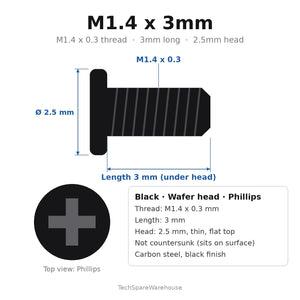
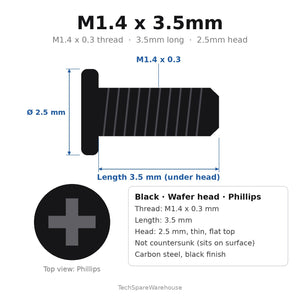
M1.4 screws represent the smallest commonly used metric fasteners in consumer electronics, measuring 1.4mm in nominal diameter. These screws appear in smartphones, smartwatches, wireless earbuds, and ultra-compact devices where every fraction of a millimeter matters. Thread pitch typically measures 0.3mm.
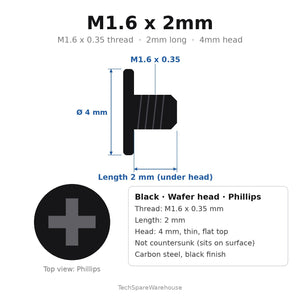
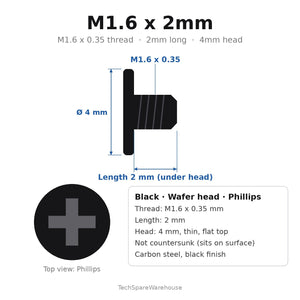
M1.6 screws at 1.6mm diameter with 0.35mm thread pitch bridge the gap between M1.4 and M2 sizes. This size appears in tablets, compact cameras, fitness trackers, and portable electronics that require slightly more holding strength than M1.4 provides.
M2 screws measuring 2mm in diameter with 0.4mm pitch represent the upper end of tiny electronics screws. While still very small, M2 screws offer significantly more strength than M1.4 or M1.6, making them suitable for components subjected to stress or requiring secure long-term retention.
Thread Pitch and Engagement
Fine thread pitches characterize tiny electronics screws. M1.4 screws use 0.3mm pitch, M1.6 use 0.35mm, and M2 use 0.4mm. These fine threads provide maximum thread count per unit length, improving resistance to vibration loosening in portable devices.
Thread engagement depth should equal at least 1.5 times the screw diameter for adequate holding strength. For M1.4 screws, this means minimum 2.1mm engagement; for M1.6 screws, 2.4mm; for M2 screws, 3mm.
Common Applications by Device Type
Smartphones use primarily M1.4 and M1.6 screws for internal assembly. These screws secure logic boards, camera modules, speaker assemblies, battery connectors, and structural brackets within housings measuring only 7mm to 9mm thick.
Tablets employ M1.6 and M2 screws depending on component size and weight. Display assemblies, battery retention, and logic board mounting typically use M2 screws for improved holding strength, while smaller components use M1.6.
Wearable devices including smartwatches and fitness trackers rely on M1.4 screws almost exclusively due to extreme miniaturization. The tiny case dimensions leave no room for larger fasteners.
Measurement and Identification
Digital calipers with 0.01mm resolution provide the accuracy needed to distinguish between tiny screw sizes. Measure thread diameter at the widest point—M1.4 measures 1.4mm, M1.6 measures 1.6mm, M2 measures 2.0mm.
Thread pitch verification requires magnification and specialized gauges. The 0.05mm to 0.1mm pitch differences between sizes are nearly impossible to judge without proper tools.
Visual identification is unreliable for tiny screws. The 0.2mm diameter difference between M1.4 and M1.6 screws cannot be judged by eye. Always measure when identification is uncertain.
Installation Challenges and Techniques
Magnetic screwdrivers are essential for handling tiny electronics screws. The screws are so small that dropping one makes recovery difficult, and magnetism helps retain screws on the driver tip during installation.
Magnification aids installation accuracy. Using magnifying glasses or microscopes helps align screws with threaded holes and verify proper thread engagement, critical when working with screws measuring less than 2mm in diameter.
Apply minimal installation torque. Tiny screws require only 0.05 to 0.15 Nm of torque—barely more than finger-tight. Over-tightening instantly strips threads in plastic mounting posts or shears the screw shaft.
Common Installation Errors
Cross-threading destroys tiny screw threads immediately due to the fine pitch and small diameter. If a screw doesn't start threading smoothly, back it out and restart rather than applying force.
Mixing screw sizes during reassembly creates problems. M1.4 screws fit loosely in M1.6 holes, while M1.6 screws won't thread into M1.4 holes. Organize screws by location during disassembly.
Using worn or incorrect screwdrivers strips screw heads. The tiny drive recesses require precision tools in excellent condition. Replace worn drivers before attempting repairs.
Organization During Repairs
Photograph screw locations before removal. Compact electronics often use different screw lengths in different positions, and mixing them causes assembly problems.
Use compartmented trays with labels for each screw location. The tiny size makes screws easy to lose, and organization prevents confusion during reassembly.
Keep tiny screws separate from larger sizes. Even M2 and M2.5 screws look similar, and mixing them leads to installation errors.
Material Considerations
Stainless steel tiny screws resist corrosion in devices exposed to moisture or humidity. The material's strength suits the small diameter, though installation requires care to prevent thread damage.
Steel screws with zinc or black oxide plating provide adequate performance for indoor electronics at lower cost than stainless steel.
Avoid aluminum tiny screws except in weight-critical applications. The soft material strips easily at these small diameters.
Replacement Screw Sourcing
Device-specific screw kits contain the exact sizes and lengths used in popular smartphones and tablets. These kits eliminate guesswork and provide screws with matching finishes.
General electronics screw assortments include multiple tiny screw sizes and lengths. While less specific than device kits, assortments provide flexibility for various repairs.
When ordering replacement screws, specify diameter, thread pitch, and length exactly. The small sizes leave no room for approximation.
Preventing Screw Loss
Work over a clean, light-colored surface to make dropped screws visible. Tiny screws disappear easily on dark or cluttered work surfaces.
Use magnetic parts trays to retain screws during disassembly. The magnetism prevents screws from rolling away if the tray is bumped.
Keep spare tiny screws in stock. The low cost and high loss rate make maintaining an inventory of common sizes practical.
Conclusion
Tiny screws for electronics require precise identification, careful handling, and proper installation techniques due to their extremely small dimensions. Understanding the M1.4, M1.6, and M2 size range, using appropriate tools, and applying minimal torque prevents the thread damage and component failures that result from improper fastener selection or installation. Accurate measurement and organization ensure successful repairs of compact electronic devices.