Quick answer
- Small metric screws encompass fastener sizes from M1.4 through M3, representing the range most commonly used in electronics assembly, computer hardware, and precision devices.
Small metric screws encompass fastener sizes from M1.4 through M3, representing the range most commonly used in electronics assembly, computer hardware, and precision devices. These compact fasteners enable secure component retention in space-constrained applications where larger screws would be impractical or impossible to use.
Technicians, repair professionals, and DIY enthusiasts search for small metric screw information when working on laptops, smartphones, tablets, cameras, drones, and various consumer electronics. Understanding the size range, specifications, and applications of these fasteners is essential for successful repairs and assemblies.
Small Metric Screw Size Range
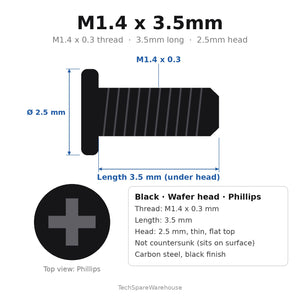
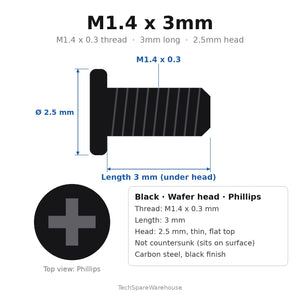
M1.4 screws represent the smallest commonly available metric fasteners, with a 1.4mm nominal diameter. These tiny screws appear in smartphones, smartwatches, and ultra-compact electronics where space is at an absolute premium. Thread pitch typically measures 0.3mm.
M1.6 screws measure 1.6mm in diameter with 0.35mm thread pitch. This size bridges the gap between M1.4 and M2, appearing in tablets, small cameras, and compact portable devices.
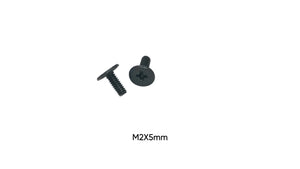
M2 screws at 2mm diameter with 0.4mm pitch represent perhaps the most common small metric size in laptop computers and consumer electronics. This size offers a good balance between compact dimensions and adequate holding strength.
M2.5 screws measure 2.5mm in diameter with 0.45mm thread pitch, appearing in larger laptops, desktop computer components, and electronics requiring more robust fastening than M2 provides.
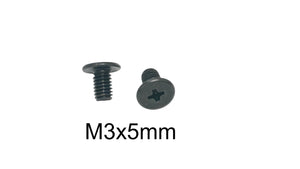
M3 screws at 3mm diameter with 0.5mm pitch represent the upper end of small metric screws, used in desktop computers, external hard drives, and electronics where component weight or stress requires stronger fastening.
Thread Pitch Specifications
Thread pitch—the distance between adjacent thread peaks—decreases proportionally with screw diameter in small metric sizes. M1.4 screws use 0.3mm pitch, M1.6 use 0.35mm, M2 use 0.4mm, M2.5 use 0.45mm, and M3 use 0.5mm.
Fine thread pitches offer advantages in electronics applications. The increased number of threads per unit length provides better resistance to vibration loosening, important in portable devices subjected to movement and handling.
Thread engagement depth should equal at least 1.5 times the screw diameter for adequate holding strength. For M2 screws, this means minimum 3mm engagement; for M2.5 screws, 3.75mm; for M3 screws, 4.5mm.
Common Length Ranges
Small metric screws are manufactured in lengths from 2mm to 30mm or longer, though electronics applications typically use lengths between 3mm and 16mm. Very short screws (2mm to 4mm) secure thin components like circuit boards and small brackets.
Medium lengths (5mm to 10mm) handle general assembly tasks. Longer screws (12mm to 20mm) accommodate stacked components or thick materials.
Length measurement convention depends on head style. Pan, button, and round head screws measure from the underside of the head to the tip. Countersunk (flat head) screws measure from the top of the head.
Head Style Variations
Pan head screws provide low-profile mounting with a flat bearing surface and slightly rounded top. This style dominates small metric screw applications due to its compact dimensions and adequate bearing surface for thin materials.
Countersunk (flat head) screws create flush surfaces when installed in properly countersunk holes. The 90-degree head angle matches standard countersink bits. This style prevents snagging in compact electronics.
Button head and socket head cap screws offer higher strength with cylindrical heads and hex socket drives. These screws allow greater installation torque than Phillips or slotted drives.
Drive Type Options
Phillips drives dominate small metric screws in consumer electronics due to widespread tool availability. PH000, PH00, and PH0 sizes correspond to M1.4/M1.6, M2/M2.5, and M3 screws respectively.
Hex socket drives provide superior torque transfer and eliminate cam-out problems. Socket sizes from 1.3mm to 2.5mm accommodate M1.6 through M3 screws.
Torx drives appear in premium electronics and devices where manufacturers want to discourage unauthorized repairs. T4, T5, and T6 sizes are common for small metric screws.
Application-Specific Size Selection
Smartphone internal assembly uses primarily M1.4 and M1.6 screws due to extreme space constraints. These tiny fasteners secure circuit boards, camera modules, speaker assemblies, and structural brackets.
Laptop computers employ M2 and M2.5 screws extensively. Ultrabooks favor M2 screws for weight and space savings, while larger laptops and mobile workstations use M2.5 screws for improved holding strength.
Desktop computer components use M3 screws predominantly, with occasional M2.5 screws for specific applications. Motherboard standoffs, expansion card brackets, drive bay mounting, and case assembly all typically use M3 fasteners.
Consumer electronics including cameras, drones, portable audio devices, and gaming peripherals use the full range of small metric screws depending on device size and component weight.
Material and Finish Considerations
Steel screws offer the best strength-to-cost ratio for general applications. Zinc plating provides basic corrosion resistance suitable for indoor electronics. Black oxide finishes reduce reflectivity and offer minimal corrosion protection.
Stainless steel screws resist corrosion in humid environments or outdoor applications. The material's non-magnetic properties benefit installations near sensitive electronics.
Aluminum screws reduce weight in portable electronics and weight-critical applications like drones. The soft material requires extremely careful installation to prevent thread stripping.
Measurement and Identification
Digital calipers provide accurate diameter measurement for small metric screws. Measure across the outer threads at the widest point. M1.4 measures 1.4mm, M1.6 measures 1.6mm, M2 measures 2.0mm, M2.5 measures 2.5mm, and M3 measures 3.0mm.
Thread pitch verification uses thread pitch gauges or manual counting. Count threads within a measured distance and calculate pitch.
Visual comparison helps when multiple screw sizes are available, but the small size differences make definitive identification difficult without measurement.
Installation Techniques for Small Screws
Use properly sized screwdrivers to prevent cam-out and head damage. Magnetic drivers help retain small screws during installation, preventing drops into device housings.
Start screws by hand when possible, turning counter-clockwise until feeling the thread drop into place, then proceed clockwise. This technique ensures proper thread alignment and prevents cross-threading.
Apply minimal torque during installation. Small metric screws require very little force to achieve secure retention—typically 0.1 to 0.5 Nm depending on size.
Common Problems and Solutions
Cross-threading damages both screws and threaded holes, occurring when installation begins at an angle. If a screw resists initial threading, back it out completely and restart rather than forcing it.
Stripped screw heads result from using incorrect screwdriver sizes or applying excessive force. If a head strips during removal, try a slightly larger driver or use a rubber band between driver and screw for added grip.
Lost screws during disassembly create reassembly challenges. Use magnetic parts trays or compartmented containers to organize screws by location and size.
Organizing Small Metric Screw Inventory
Assortment kits containing multiple sizes and lengths provide convenient replacement options. Kits organized by size with clearly labeled compartments reduce identification time and ensure appropriate replacements are available.
Store screws in labeled containers to prevent mixing sizes. The small diameter differences between M2 and M2.5 screws make visual identification unreliable.
Conclusion
Small metric screws from M1.4 through M3 provide essential fastening solutions for compact electronics and precision devices. Understanding size specifications, thread pitch requirements, and proper installation techniques ensures successful repairs and assemblies. Accurate identification and careful handling of these tiny fasteners prevents the component damage and assembly failures that result from using incorrect sizes or improper installation methods.