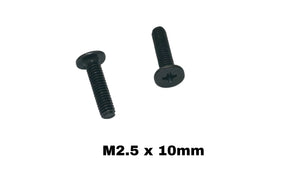
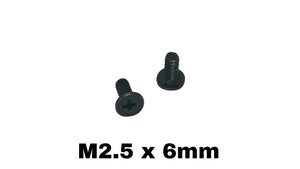
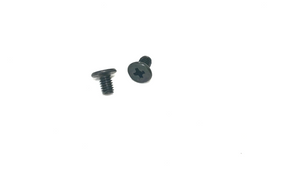
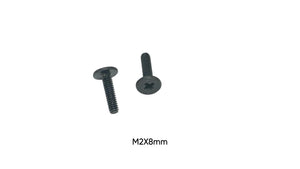
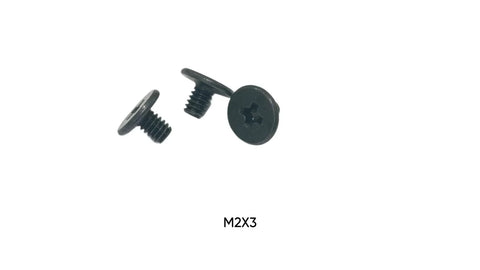
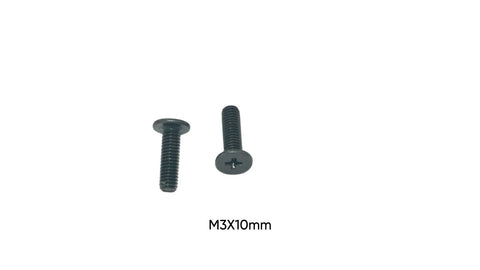
Quick answer: most cartridges use the half-inch mount: two screws spaced 12.7mm apart through slots in the headshell. The screws are usually M2.5; some older and US-made hardware uses 2-56. Choose a length that passes through the headshell and the cartridge body and leaves room for a nut where one is needed, typically somewhere in the 6 to 14mm range depending on cartridge height. Tighten just enough to stop the cartridge moving.
Cartridge screws are tiny, easy to lose, and often the wrong length for a new cartridge. Getting them right makes alignment easier and keeps the cartridge from shifting.
The half-inch mount
The half-inch (also called standard) mount has two mounting holes in the cartridge body, 12.7mm apart. The headshell has two matching slots, which let you slide the cartridge forward or back to set overhang during alignment.
The cartridge's holes come in two styles:
- Threaded holes: the screw threads directly into the cartridge body. No nut needed.
- Plain (through) holes: the screw passes through and is held by a small nut on the other side.
Check which you have before choosing a length.
M2.5 or 2-56?
| M2.5 | 2-56 UNC | |
|---|---|---|
| Diameter | 2.5mm | about 2.18mm |
| Thread | 0.45mm pitch | 56 threads per inch (about 0.45mm) |
| Where you see it | Most current cartridges and headshells | Some older and US-made hardware |
Because the thread pitches are similar, a 2-56 screw can start in an M2.5 hole and feel almost right. It will then be loose and won't clamp properly. Measure the diameter with calipers if you're unsure.
Choosing the screw length
- Measure the headshell's mounting flange thickness where the screw passes through.
- Measure the cartridge body height at the mounting holes. For threaded holes, measure how deep the thread goes.
- Add them up. For threaded cartridges, choose a screw that engages several threads but doesn't bottom out. For through-hole cartridges, add room for the nut plus a thread or two.
- Check the stylus clearance. A screw that's too long can protrude below the cartridge and sit too close to the record. Make sure nothing sticks out past the bottom of the body.
Cartridge heights vary, which is why replacement screws come in a range of lengths. Our audio equipment screws include M2.5 flat heads in 8, 10, 12 and 14mm.
Fitting a cartridge, step by step
- Protect the stylus. Leave the stylus guard on throughout.
- Connect the tonearm wires first, usually colour coded: white (left +), blue (left −), red (right +), green (right −). Push the clips on gently with tweezers.
- Insert the screws through the headshell slots into the cartridge, and add nuts if your cartridge needs them.
- Snug them lightly, just enough to hold the cartridge while you align it.
- Align using a protractor for your tonearm, sliding the cartridge along the slots.
- Tighten evenly, a little at a time on each screw, until the cartridge doesn't move. Don't crank them. Cartridge bodies can crack.
- Re-check alignment after tightening, then set tracking force and anti-skate.
Steel, aluminium or nylon screws?
Steel screws are common and strong. Some listeners prefer aluminium, brass or nylon because they are non-magnetic and lighter. Moving-magnet and moving-coil cartridges contain magnets, and some people prefer to keep magnetic material away from them. Many setups use steel without issue. The bigger factors are correct length and even tightening.
Other small screws in audio gear
The same M2 to M3 sizes turn up all over audio equipment: XLR connector shells, microphone bodies and clips, and headphone headbands. When one goes missing, measure the diameter and length the same way. Our audio equipment screws collection includes sizes for these jobs. For measuring tips, see the M2 vs M2.5 vs M3 guide, and for driver sizes see screwdriver bits for small screws.
Troubleshooting
| Problem | Likely cause | Fix |
|---|---|---|
| Screw spins but won't tighten | Wrong thread (2-56 in an M2.5 hole, or the reverse), or a stripped thread | Measure the screw; use a nut if the cartridge thread is damaged and the holes allow it |
| Cartridge twists during alignment | Screws too loose, or one tighter than the other | Tighten both a little at a time, evenly |
| Screw tip visible under the cartridge | Screw too long | Use the next shorter length |
| Screw won't reach the nut | Screw too short | Use the next longer length |
| Lost a nut | Common; they're tiny | Work over a tray and keep spares |
Keep a small spares set
Because cartridge heights differ, a few screws in each length from 6 to 14mm, plus spare nuts and washers, covers most cartridge swaps. Store them in a labelled box with your alignment protractor and stylus brush.
For other M2.5 lengths, see all M2.5 screws.
FAQ
What size screws do turntable cartridges use?
Half-inch mount cartridges usually use M2.5 screws. Some older hardware uses 2-56. Measure to confirm.
How long should cartridge screws be?
Long enough to pass through the headshell and engage the cartridge or nut, but not so long that they stick out below the cartridge body. Measure your cartridge's height.
Do I need nuts?
Only if your cartridge has plain through-holes. Threaded cartridge bodies don't need nuts.
How tight should cartridge screws be?
Just tight enough that the cartridge can't move. Tighten evenly and gently; overtightening can crack the body.
Do I need washers under cartridge screws?
Some headshells use small washers under the screw heads or nuts to spread the clamping on the slots. Use them if your headshell came with them.
Can I reuse my old cartridge screws on a new cartridge?
Yes, if the thread matches and the length suits the new cartridge's height. Check both before fitting.