Quick answer: most drones use metric screws in four sizes. M3 holds 5" and larger FPV frames, arms and 30.5mm flight stacks. M2 holds micro frames, 20mm stacks and small motors. M1.4 and M1.2 turn up on whoop-class motors, small props and canopies. Length matters more than on almost any other device: a motor screw that's too long can touch the motor windings, so measure before you swap.
Drones shed screws. Crashes, vibration and frequent rebuilds mean screws loosen, strip or simply vanish in long grass. Knowing which size goes where makes field repairs quick.
Common drone screw sizes by job
| Job | Typical size | Notes |
|---|---|---|
| 5" to 7" FPV frame plates and arms | M3 | Flat heads on the bottom plate keep it smooth |
| 30.5 x 30.5mm flight stack | M3 | Often with rubber grommets for soft mounting |
| 20 x 20mm flight stack | M2 or M3 | Check the board's hole size |
| Micro and toothpick frames | M2 | Light screws keep weight down |
| Motors from about 1103 to 1404 size | M2 | Length is critical |
| Larger FPV motors (22xx to 28xx) | M3 | Length is critical |
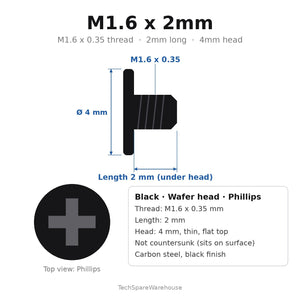
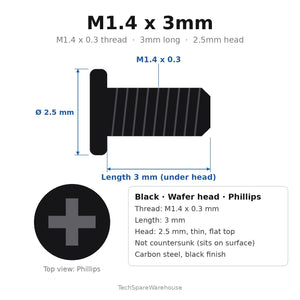
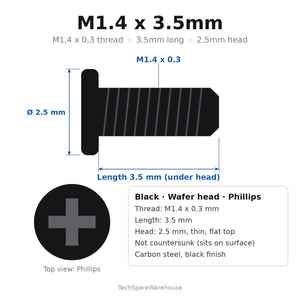
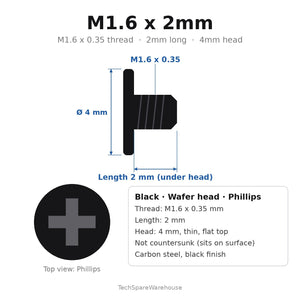
| Whoop motors, small props, canopies | M1.2 to M1.4 | Often tiny Phillips heads |
These are common patterns, not rules. Check the hole size with calipers or by test-fitting a known screw. Our M2 vs M2.5 vs M3 chart shows how to measure.
Choosing the right length
Frame screws
Add the thickness of every layer the screw passes through, then aim for at least three full threads engaged in the nut or standoff. Too short and the screw strips. Too long and it sticks out, catches on things or adds weight.
Motor screws: the length that matters most
Motor screws pass through the arm into threaded holes in the motor base. Directly above those holes sit the motor windings. A screw that's too long can touch the windings and damage the insulation, which can short the motor or the ESC.
- Measure the arm thickness at the motor mount.
- Check how deep the motor's threaded holes are. The motor's spec sheet often lists a maximum screw length.
- Pick a screw that fills most of the hole but stops short of its full depth.
- After fitting, spin the motor by hand. It should turn freely, with no scraping.
If you change arm thickness, for example a new frame, re-check the motor screw length.
Flat heads vs other heads on drones
- Flat (countersunk) heads suit bottom plates and motor mounts with countersunk holes. They sit flush, so they don't snag on landing.
- Button or pan heads suit top plates and stacks with plain holes.
Our countersunk vs pan head guide explains the difference, including how length is measured on each.
Threadlocker: yes, but carefully
- Use a small dab of medium-strength threadlocker on metal-into-metal screws such as motor screws and standoffs. Vibration loosens dry screws.
- Keep threadlocker away from plastic. Some threadlockers attack certain plastics, including polycarbonate, and can cause cracking. Check the product's guidance.
- Let it cure before flying.
Field repair kit
A small box in your flight bag saves a day out:
- Spare M3 and M2 frame and motor screws in the lengths you use.
- A few M1.2 or M1.4 screws if you fly whoops or micro drones.
- Hex and Phillips drivers in the right sizes. Our screwdriver bit guide matches PH000 to PH1 to screw size.
- Spare props and a small tube of threadlocker.
Browse our drone screws collection for M1.2, M2 and other sizes, and micro electronics screws for the smallest sizes.
Replacing propeller screws on mini drones
Many small camera drones hold each propeller with one tiny screw. These strip easily because the hub is plastic. Turn gently, stop as soon as the screw seats, and replace any screw whose head is rounded. Keep the drone's own instructions to hand for prop orientation.
Signs a drone screw needs replacing
- Rounded drive recess: the driver slips before the screw is tight.
- Bent shank: common after crashes on arm and motor screws. A bent screw won't seat squarely and can loosen again.
- Stretched or damaged threads: the screw tightens, then keeps turning.
- Corrosion: after flying in wet grass or near salt water.
Screws are cheap compared with the parts they hold. When in doubt, swap it.
Plan the rebuild
When you rebuild after a crash, lay the screws out in the order they came out and replace them in sets. Mixing old and new motor screws on one motor makes it harder to spot which one was the problem if it loosens again.
Shop by size: M1.2 screws, M2 screws and M3 screws.
FAQ
What screws do FPV drones use?
Mostly M3 on 5" and larger frames and motors, M2 on micro builds and small motors, and M1.2 to M1.4 on whoop-class parts.
How long should motor screws be?
Long enough to engage most of the threaded hole, but short enough not to reach the windings. Check the motor's maximum screw length and spin-test after fitting.
Should I use steel or titanium screws?
Steel is common and inexpensive. Titanium saves a little weight. Either works if the size and length are right.
Why do my drone screws keep loosening?
Vibration. Use medium threadlocker on metal threads and check screws after each crash.
What screws hold small drone propellers?
On many mini camera drones, a single small screw around M1.2 to M1.4 holds each prop. Turn gently, since the hub is plastic.
Do flight stacks need special screws?
Stacks usually mount on M2 or M3 screws or standoffs, often through rubber grommets. Match the board's hole size.