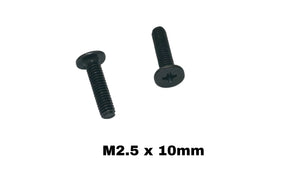
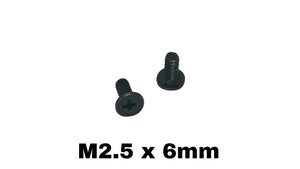
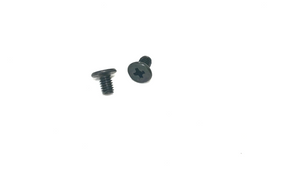
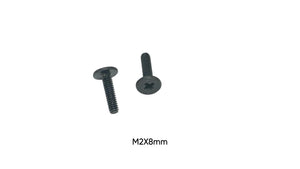
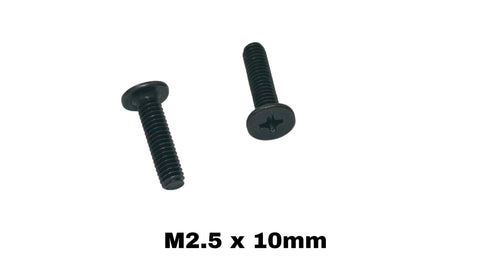
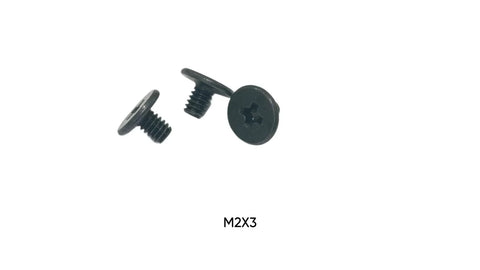
Quick answer: a countersunk (flat head) screw has a cone-shaped underside that sits inside a matching cone-shaped recess, so the top of the head finishes flush with the surface. A pan head has a flat underside and sits on top of the surface. The key practical difference: a countersunk screw's length is measured including the head, while a pan head's length is measured from under the head. Fit the wrong type and the head either sticks up or sinks too deep and grips nothing.
Most small electronics use metric machine screws in M1.4 to M3, and both head types are common. Telling them apart takes seconds once you know what to look for.
How to identify the head type
| Feature | Countersunk (flat head) | Pan head |
|---|---|---|
| Top of head | Flat | Slightly domed |
| Underside | Cone (usually 90° on metric screws) | Flat |
| Sits | Flush with the surface | On top of the surface |
| Hole needs | A countersunk recess | A flat seat |
| Length measured | Top of head to tip | Under head to tip |
Look at the screw from the side. If the head tapers like a funnel, it is countersunk. If it has a flat step under the head, it is a pan head (or a wafer or cheese head, which also sit on top).
Where countersunk screws are used in electronics
- Laptop bottom cases, where a flush head stops the screw catching on a desk or bag.
- Drive brackets and caddies, where the screw head has to clear a slot or rail. See our HDD bracket and caddy screws.
- Keyboard plates and cases, where a protruding head would hit a switch or the desk.
- Drone frames and RC chassis plates, where flush heads keep the underside smooth.
- Hinge brackets, where a head that stands proud would stop the hinge closing.
Where pan heads are used
- Into threaded standoffs on circuit boards, where the board has no countersink.
- Through thin sheet metal that is too thin to countersink.
- Anywhere the screw clamps a part with a flat seat.
Why swapping head types causes trouble
Pan head in a countersunk hole
The flat underside touches only the rim of the recess. The head sits proud and can rock. On a laptop base it may stop the case closing or scratch the surface it sits on.
Countersunk head on a flat seat
The cone presses on a small ring of material. On soft plastic it can split the boss or pull through. On a circuit board it concentrates force on a small area, which you don't want near traces.
Measuring a countersunk screw correctly
This is where most ordering mistakes come from.
- Diameter: measure across the threads with calipers. About 2mm is M2, about 2.5mm is M2.5, about 3mm is M3. Our M2 vs M2.5 vs M3 guide has a full chart.
- Length: on a countersunk screw, measure from the flat top of the head to the tip. An M2 x 4mm flat head is 4mm long overall.
- Head diameter: worth noting if the recess is shallow, since a larger head may not sit flush.
On a pan head, the same "4mm" would be measured from under the head, so the screw is physically longer overall. Ordering a pan head by a countersunk measurement leaves you with a screw that's too long.
Are short M2 screws fully threaded?
Usually, yes. Short metric machine screws in small sizes are normally threaded right up to the head, because there isn't room for an unthreaded shank. That is helpful: a fully threaded short screw engages every available thread in a shallow boss. Longer screws may have a short plain section under the head.
Drive types you will see
- Phillips: the most common on small replacement screws. PH00 and PH0 drivers cover most M2 to M3 heads.
- Torx: common on newer laptops and consoles. See our Torx T6 guide.
- Pentalobe: used on some Apple devices. See our pentalobe guide.
Our guide to screwdriver bits for small screws matches driver to screw size.
Buying replacement flat head screws
Most of our replacement screws are black carbon-steel Phillips flat heads in M1.2 to M3. Browse laptop internal screws for laptop sizes, hobby and DIY screws for keyboards, 3D printers and RC, or the micro electronics screws for M1.2 to M1.6.
Other head styles you may find
- Wafer head: a very thin, wide pan-style head, common in laptops where height is tight.
- Cheese head: a taller cylindrical head that sits on top of the surface.
- Raised countersunk (oval): countersunk underneath with a slightly domed top. Length is still measured to the widest point of the head's top edge.
Shopping by size? See all M2 screws, M2.5 screws and M3 screws.
FAQ
Is a flat head screw the same as a countersunk screw?
In machine screws, yes. "Flat head" describes the flat top, and "countersunk" describes how it sits in a recess.
How is a countersunk screw's length measured?
From the top of the head to the tip, because the whole head sits inside the material.
Can I use a countersunk screw in a hole without a countersink?
It will stand proud and concentrate force on a small ring. Use a pan head there, or countersink the hole if the material allows.
What angle are metric countersunk screws?
Metric flat head machine screws normally use a 90° head. Some imperial screws use 82°, so don't mix them in the same recess.
Why does my replacement flat head sit too deep?
Its head is smaller than the recess, or the recess has been worn. Use a screw with the matching head diameter.